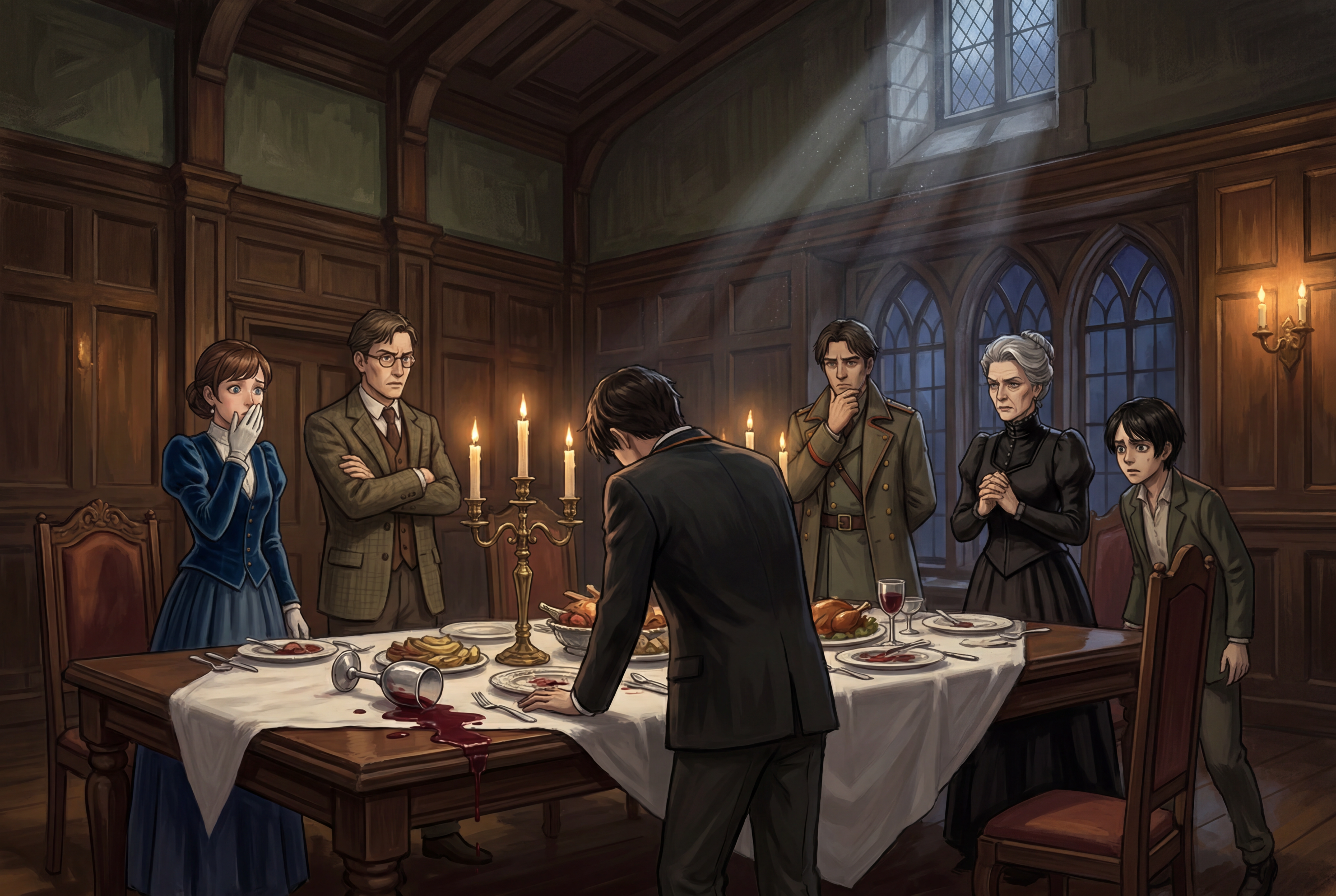
The body is found. You have no idea who did it. Neither does the engine.
In most AI mystery games, the killer is decided before you start and the story just drip-feeds you clues until you guess right. That's not a mystery. That's a quiz. In The Reader's Path, the murder mystery spine sets up a death, establishes suspects, and lets your investigation determine who the killer actually becomes. The engine tracks what you discover, who you question, what alibis hold up under scrutiny, and which threads you pull. The killer crystallizes from the story itself, not from a predetermined script.
Every NPC in the world has their own relationships, secrets, and motivations. When someone dies, the engine knows who had motive, who had opportunity, and who was where at what time. When you interrogate the innkeeper, he remembers that you were rude to him on turn 3. When you search the victim's room, the engine checks what items the state tracker has placed there based on the story so far. Nothing is spawned for your convenience. Everything was already there.
The common complaint with AI storytelling tools is that they can't maintain consistency. Characters contradict themselves, timelines break, and the mystery dissolves into nonsense by turn 20. The Reader's Path solves this with a state tracking system that knows where every character was, what they said, and what they know. When a suspect tells you they were at the docks all evening, the engine knows whether that's true. You just have to figure out how to prove it.
The mystery deepens the more you investigate. Ignore a clue and it doesn't wait for you. Other characters act on their own knowledge. The killer might cover their tracks. Witnesses might leave town. The story doesn't pause because you went to bed. It moves, and you move with it.